Svn builds
Содержание:
- Notable features in DOSBox-X
- Файлы и папки DOSBox.
- Установка DOSBox «ручками».
- Алгоритм работы DOSBox.
- Шаги
- Misc
- Gravis Ultrasound
- PC Speaker
- Known DOSBox-X forks
- How to speed up/slow down DOSBox
- На что обратить внимание и где скачать.
- Source Code Packages (zip or tar.gz)
- На что обратить внимание и где скачать.
- DOSBox
- macOS Packages (Portable)
- C
- What is DOSBox?
- Performance
Notable features in DOSBox-X
Although based on the DOSBox project, DOSBox-X is now a separate project because both have their own separate schedules and development priorities. For example, the main focus of DOSBox is for running DOS games whereas DOSBox-X goes way beyond this. At this time DOSBox-X already has a great number of features that do not exist in DOSBox. Examples of such features include:
-
GUI drop-down menu and built-in graphical configuration tool
-
Save and load state support (with up to 100 save slots + save files)
-
NEC PC-98, AX, DOS/V emulation and Chinese/Japanese/Korean support
-
Fully translatable user interfaces (with language files available)
-
Better support and compatibility with DOS applications
-
Support for more DOS commands and built-in external tools
-
Support for CPU types like Pentium Pro and MMX instructions
-
Support for IDE interfaces and improved Windows 3.x/9x emulation
-
Support for long filenames and FAT32 disk images (DOS 7+ features)
-
Support for pixel-perfect scaling output for improved image quality
-
Support for TrueType font (TTF) output for text-mode DOS programs
-
Support for printing features, either to a real or to a virtual printer
-
Support for starting programs to run on the host systems (-hostrun option)
-
Support for 3dfx Voodoo chip and Glide emulation (including Glide wrapper)
-
Support for cue sheets with FLAC, MP3, WAV, OGG Vorbis and Opus CD-DA tracks
-
Support for FluidSynth MIDI synthesizer (with sound fonts) and MT-32 emulation
-
Support for NE2000 Ethernet for networking features and modem phone book mapping
-
Support for features such as V-Sync, overscan border and stereo swapping
-
Plus many more..
DOSBox-X officially supports both SDL 1.2 and SDL 2.0; both 32-bit and 64-bit builds are also supported.
Файлы и папки DOSBox.
Перечислим все папки и файлы, которые появятся при стандартной установке DOSBox на жёстком диске.
В директории C:\Program Files (x86)\DOSBox-0.74-2 :
- Documentation — содержиться документация на английском языке.
- Video Codec — необходимые файлы и инструкция по видеозахвату. Позволяет снимать и сохранять видимое изображение в окне DOSBox или в режиме полного экрана со звуком или без него.
В рабочей директории пользователя:
DOSBox\Capture.
В директории В директории C:\Program Files (x86)\DOSBox-0.74-2 и вложенных директориях:
- DOSBox.exe — собственно программа-эмулятор DOS.
- SDL.dll — поддержка Simple DirectMedia Library (http://www.libsdl.org). Не стандартный интерфейс для подключения CD-ROM, джойстика и т.п.
- SDL_net.dll — для поддержки модемов (ipx support).
- stderr.txt, stdout.txt — текстовые лог-файлы, куда перенаправляется информация с консоли DOSBox (DOSBox Status Window). Стандартный запуск DOSBox вызвает отображение двух консольных окон: окно эмуляции системы MS-DOS и окно отображающее процесс работы эмулятора. При запуске DOSBox с параметром -noconsole консоль (сonsole) работы самого эмулятора не проявиться, отобразиться только консольное окно, непосредственно эмулирующее виртуальную машину DOS. В принципе, файлы stderr.txt, stdout.txt создаются в любом случае, просто при параметре -noconsole они не будут удаляться при прекращении работы программы DOSBox.
- DOSBox 0.74 Manual.txt — инструкция пользователя на английском.
- DOSBox 0.74 Options.bat — батник, который отобразит файл конфигурации DOSBox при помощи текстового редактора notepad, встроенного в Windows. В случае внесения изменений необходимо сохранить изменённый файл настроек в какубю-либо директорию. Как его загрузить — расскажем в статье, посвящённой настройкам DOSBox.
- Reset KeyMapper.bat — запуск батника позволяет выставить по умолчанию настройки расклада клавиатуры.
- Reset Options.bat — батник выставляет настройки DOSBox по умолчанию.
- Screenshots & Recordings.bat — запускает захват основного экрана эмуляции DOS.
- uninstall.exe — анинсталировать DOSBox из системы.
В рабочей директории пользователя и вложенных директориях:
- dosbox-0.74-2.conf.
- аудио и видео файлы (при использовании возможности видео перехвата).
Установка DOSBox «ручками».
Не знаю, как будет с установкой DOSBox новой — 64 битной версии 0.75 в виде Portable режима, то есть без установочного *.exe файла, но на данный момент всё просто. Достаточно скопировать все файлы и директории в выбранную Вами папку. При этом туда же (в директорию с основным файлом DOSBox.exe) необходимо поместить dosbox.conf и директорию видеозахвата Capture. Файл dosbox.conf представляет собой текстовый файл, скорректированный по вашему усмотрению на основе dosbox-0.74-2.conf . При отсутствии файла dosbox.conf, конфигурационный файл, соответствующий версии DOSBox (в нашем случае — dosbox-0.74-2.conf ) будет создан автоматически на время рабочей сессии программы с настройками по умолчанию (C:\Users\User-1\AppData\Local\DOSBox\dosbox-0.74-2.conf ).
Алгоритм работы DOSBox.
Рассмотрим краткий алгоритм запуска эмулятора DOS версии 0.74-2. Он включает следующие шаги:
- Обработка параметров командной строки.
- Обработка файла конфигурации, согласно параметра командной строки, либо dosbox.conf (если файл присутствует в директории программы).
- Обработка dosbox-0.74-2.conf (в случае отсутствия dosbox.conf ). DOSBox загрузит файл из профиля пользователя (dosbox-0.74-2.conf). Если такого файла нет, то он будет создан.
При запуске DOSBox.exe сначала обрабатываются параметры командной строки. Именно на этом основана работа т.н. батников (файлы с расширением *.bat), входящих в стандартный набор файлов: DOSBox 0.74-2 Options.bat, Reset KeyMapper.bat, Reset Options.bat, Screenshots & Recordings.bat. Если интересно, то их содержание просмотрите с помощью любого текстового редактора (notepad.exe). Предназначение указанных батников понятно из смысловых названий.
Параметры командной строки можно задать через ярлык: создаём ярлык файла DOSBox.exe и добавляем в строку запуска -noconsole, как это показано на картинке. Теперь, при запуске программы через ярлык, DOSBox Status Window (дополнительное консольное окошко — т.н. «Окно состояния DOSBox «) не будет отображаться. Возможные ошибки и дополнительная информация будет выводиться через файлы stderr.txt, stdout.txt, генерирующий при запуске DOSBox.
Запуск DOSBox в одном окне:

Запуск DOSBox с параметром: DOSBox.exe -noconsole .
DOSBox.exe -conf dosbox.conf -noconsole
Как уже было сказано, файл конфигурации можно задать параметром командной строки -conf (например: «DOSBox.exe -conf my_dosbox.conf«). При отсутствии параметра -conf, DOSBox.exe обрабатывает другие параметры.
После обработки всех параметров командной строки (при отсутствии параметра -conf), DOSBox пытается обработать файл dosbox.conf. Ещё раз повторимся, dosbox.conf должен быть в директории, куда установлен эмулятор — в одной директории с DOSBox.exe. Содержание его основано на файле dosbox-0.74-2.conf . Поэтому запускаем DOSBox.exe и находим его в рабочей директории профиля пользователя (в нашем случае — C:\Users\User-1\AppData\Local\DOSBox, где User-1 — это имя пользователя) . Копируем файл в директорию с установленным DOSBox и переименовываем в dosbox.conf. Настройка DOSBox будет производиться внесением изменений в указанный файл.
Если DOSBox не находит dosbox.conf , создаётся файл dosbox-0.74-2.conf (вы уже знаете, где его найти) и последующие настройки изменяются, внесением записей в этот конфигурационный файл. Для упрощения открытия dosbox-0.74-2.conf в текстовом редакторе по умолчанию можно воспользоваться батником DOSBox 0.74-2 Options.bat.
Шаги
Часть 2
Монтирование дисков
Ниже описаны способы монтирования дисков в DOSBox. Монтирование папки с играми позволит вам запускать игры, хранящиеся в этой папке. Монтирование компакт-диска позволит вам запускать игры с CD-диска. Монтирование образа диска (файл ISO) позволит вам открывать образы дисков.
-
1
Смонтируйте папку с играми. Не стоит монтировать весь жесткий диск в DOSBox — смонтируйте только папку с играми, которая будет играть роль виртуального жесткого диска.
- Введите mount C C:\DOSGAMES и нажмите ↵ Enter. Введите C: и нажмите ↵ Enter. Приглашение изменится на C:\>.
- В macOS введите соответствующий путь, например mount C ~/DOSGAMES
-
2
Смонтируйте CD-диск. Вставьте компакт-диск в оптический привод. Введите следующие команды:
- Введите mount D D:\ -t cdrom и нажмите ↵ Enter. Замените D:\ буквой вашего оптического привода. Введите D: и нажмите ↵ Enter. Приглашение изменится на D:\> и вы сможете работать с файлами на компакт-диске.
- cdrom нужно вводить строчными буквами.
-
3
Смонтируйте образ диска (ISO-файл).
Введите imgmount D C:\ImagePath\image.iso -t iso и нажмите ↵ Enter. Замените C:\ImagePath\image.iso на путь к вашему ISO-файлу.
Если у вас есть ISO-файл с играми, смонтируйте его и работайте с ним как с настоящим диском.
-
4
Смонтируйте образ диска (BIN/CUE-файл).
Введите imgmount D C:\ImagePath\image.cue -t iso и нажмите ↵ Enter. Замените C:\ImagePath\image.cue на путь к вашему CUE-файлу. BIN-файл должен иметь то же имя и располагаться в той же папке, что и CUE-файл.
Если у вас есть BIN/CUE-файл с играми, смонтируйте его и работайте с ним как с настоящим диском.
-
5
Смонтируйте дисковод.
Введите mount A A:\ -t floppy и нажмите ↵ Enter.
Если у вас есть дисковод (для дискет), смонтируйте и работайте с ним.
-
6
Настройте автомонтирование (при запуске DOSBox). Для этого в текстовом редакторе (например, в Блокноте) откройте файл dosbox.conf.
- Windows — C:\Users\имя пользователя\AppData\Local\DOSBox\dosbox-версия.conf
- Mac — /Macintosh HD/Users/ имя пользователя/Library/Preferences/DOSBox версия Preferences
- В конце файла dosbox.conf вставьте следующие строки:
Часть 3
Запуск игры
-
1
Отобразите список папок. Каждая игра хранится в соответствующей папке, а все игры — в папке DOSGAMES. Введите dir, чтобы отобразить все папки с играми. Если вы смонтировали диск или образ диска, будет отображен список папок на диске.
-
2
Введите .cd directory, чтобы открыть папку с нужной игрой.
-
3
Введите .dir, чтобы отобразить все файлы в папке с нужной игрой.
-
4
Найдите файл, запускающий игру.
ЕХЕ-файл, как правило, носит имя самой игры. К примеру, исполняемый файл «Принца Персии» будет называться POP.EXE.
В большинстве случаев это ЕХЕ-файл, но может быть и СОМ- или ВАТ-файл.
-
5
Запустите игру. Введите имя EXE-, COM- или BAT-файла, включая расширение, и нажмите ↵ Enter.
-
6
Настройте производительность игры при помощи сочетаний клавиш. Помните, что старые игры на новых компьютерах могут работать крайне медленно.
- Нажмите Ctrl+F8, чтобы увеличить число пропускаемых кадров. Это увеличивает производительность игры, но ухудшает качество картинки.
- Нажмите Ctrl+F7, чтобы уменьшить число пропускаемых кадров.
- Нажмите Ctrl+F12, чтобы ускорить игру за счет выделения ей больших ресурсов процессора. Вы можете контролировать ресурсы процессора, нажав Ctrl+⇧ Shift+Esc и перейдя на вкладку «Эффективность». Если после этого вам все еще нужно ускорить игру, увеличьте число пропускаемых кадров.
- Нажмите Ctrl+F11, чтобы замедлить игру за счет сокращения ресурсов процессора.
- Даже после настройки параметров производительности не все игры будут нормально работать в DOSBox.
-
7
Переключитесь в полноэкранный режим. Для этого нажмите Alt+↵ Enter. Чтобы выйти из этого режима, еще раз нажмите Alt+↵ Enter.
Часть 4
Использование специальной программы
-
1
Если вы не хотите или не умеете работать с командной строкой, скачайте специальную программу (программу пользовательского интерфейса). Такая программа использует интерфейс Windows, позволяя пользователю загружать, запускать и настраивать игры без использования командной строки.
- Одной из самых популярных программ является D-Fend Reloaded, которую можно скачать на сайте dfendreloaded.sourceforge.net.
- Программа D-Fend Reloaded включает файлы DOSBox.
-
2
Запустите D-Fend Reloaded (после установки этой программы). В левой панели отобразятся установленные игры.
-
3
Добавьте игры. Для этого перетащите архив с игрой в окно D-Fend Reloaded. Архив будет автоматически распакован, а игровые файлы — помещены в нужное место.
-
4
Запустите игру. Для этого дважды щелкните по игре в левой панели. Цветовая схема вашей системы временно изменится, чтобы соответствовать цветам старых игр.
Misc
Q. What is the picture in the dosbox www site in the title bar?
A. Dune 2.
What is DOS?
DOS (see Wikipedia:DOS) is short for «Disk Operating System». It mainly refers to the series of operating systems that dominated the IBM PC compatible market from the 1980s and into the 1990s. But it may also refer to the DOS-based Microsoft Windows 9X/ME series of the late 1990s. The relevant systems were usually called «X DOS», «X-DOS» or «XDOS» with the X being the brand name. Despite common usage, none of them were actually called just DOS. Microsoft’s system, MS-DOS, is probably the most known.
What is Abandonware?
Abandonware (see Wikipedia:Abandonware) is the term people usually use to describe computer softwares and games which are neither sold nor supported anymore. As it is not an official term, it’s important to remember that just because something is considered as abandonware doesn’t mean it actually is, especially as the estimation is usually based strictly on age. Moreover, even if it is, it has no legal meaning. In other words, it still has just as much copyrights as if it was actively developed. In fact, the Entertainment Software Association (ESA — fomerly IDSA) actively pursuits those that distribute what they consider abandonware.
Gravis Ultrasound
The Gravis Ultrasound was an advanced synthesizer released by an unlikely manufacturer: Canadian joystick company Advanced Gravis. Its audio was far ahead of any other consumer device of the time, supporting wave-table synthesis, stereo sound, 14-channel playback at 44.1 KHz or a whopping 32 channels of playback at 19.2 KHz.
However, the Ultrasound eschewed any attempt at backwards-compatibility with AdLib or Soundblaster cards. Programs had to be written to specifically take advantage of its capabilities. Many DOS users kept a Sound Blaster in their PC in addition to an Ultrasound, in case they needed to run a program that did not support the more advanced card. (And in DOSBox, this can be imitated by turning on both devices in your configuration file, which is recommended.)
One quirk of the Ultrasound is that, unlike most synthesizers, it did not come with any voices pre-installed on the card. All voices had to be installed from disk either at driver load time or by the application. Because of this, a set of drivers and «patch files» is needed in order to use the Ultrasound in DOSBox. Due to incompatibilities between the license of the patch files and DOSBox’s GPL license, these files cannot be distributed with DOSBox, so you will need to download them from another website:
HuggyBaby’s Ready-To-Use DOSBox Ultrasound Folders (featuring the original GUS 4.11 set and the enhanced Pro Patches Lite 1.61 set)
GUS Install Disk Set Version 4.11
More sites with patch files can be found on the . The patch files must be unzipped to a folder that can be accessed from DOSBox’s command line. It is common practice to put these in a folder called «ULTRASND» under whatever folder you will mount as your C: drive.
The Gravis Ultrasound is configured under the gus category. It has several options, which are explained in the comments in the configuration file. Of particular note is the ultradir option, which must be set to the path to the patch files inside DOSBox. (Which is likely not the same as the path on your real hard drive.)
An Example:
If you have a folder called «Games» on your C: drive that you mount as X: in DOSBox, and then you install the patch files to C:\Games\ULTRASND\, the config entry will be
ultradir=X:\ULTRASND\
PC Speaker
The most ubiquitous audio device of all time. Built into every personal computer to this very day, the PC Speaker acts as diagnostic device during the initial booting up of a computer. (to inform the user, in a series of beeps, if there is any low level hardware issue) Early game developers utilized the PC Speaker to generate music and sound effects — to good effect. Later, some developers invented ways to generate complex audio through the PC Speaker, even reproducing voice. Very few games utilized the PC Speaker in this way, as the CPU requirements were high and the quality was severely limited. However, a Windows driver was written that allowed Windows games to utilize the PC Speaker in this manner, which was useful if the user had no other sound device.
The PC Speaker is configured under the speaker category. There are no special options to configure for the PC Speaker. If enabled, it just does what it does.
Known DOSBox-X forks
-
DOSBox-X Emscripten port (runnable in a web browser) by Yksoft1
Significant changes are made in order to run efficiently within the web browser when compiled using LLVM/Emscripten.
These significant changes require dropping some useful features (including the menus) but are required for performance.URL: https://github.com/yksoft1/dosbox-x-vanilla-sdl/tree/emscripten (look for clone URL and use the emscripten branch)
-
DOSBox-X-App (for Windows and macOS) by emendelson
DOSBox-X-App is a slightly customized version of DOSBox-X, combined with external programs and commands that make it
easy to print and create PDFs from DOS applications. It is customized for use with applications, not games. -
DOSBoxWP (for WordPerfect for DOS) by emendelson
DOSBoxWP is a customized version of DOSBox-X targetted for users of WordPerfect for DOS.
-
Win31DOSBox (Windows 3.1 for 64-bit Windows) by emendelson
Win31DOSBox aims to be an easy method of running Windows 3.x software for 64-bit Windows systems.
The system uses a custom build of DOSBox-X when running Windows 3.1x.
How to speed up/slow down DOSBox
CPU Cycles (speed up/slow down)
By default (cycles=auto) DOSBox tries to detect whether a game needs to be run with as many instructions emulated per time interval as possible (cycles=max, sometimes this results in game working too fast or unstable), or whether to use fixed amount of cycles (cycles=3000, sometimes this results in game working too slow or too fast). But you can always manually force a different setting in the DOSBox’s configuration file.
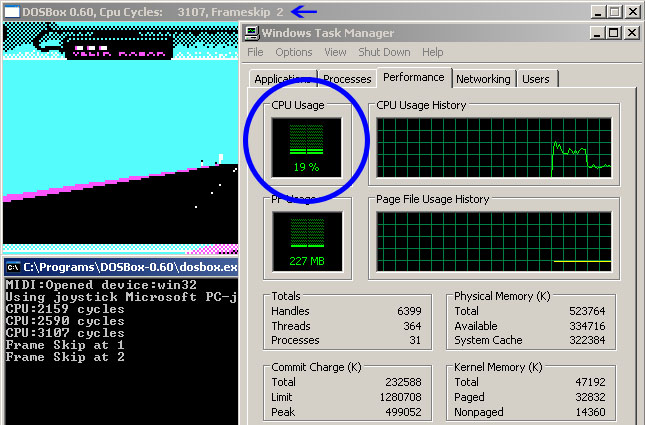
You can force the slow or fast behavior by setting a fixed amount of cycles in the DOSBox’s configuration file. If you for example set cycles=10000, then DOSBox window will display a line «Cpu Speed: fixed 10000 cycles» at the top. In this mode you can reduce the amount of cycles even more by hitting CTRL-F11 (you can go as low as you want) or raise it by hitting CTRL-F12 as much as you want, but you will be limited by the power of one core of your computer’s CPU.
You can see how much free time your real CPU’s cores have by looking at the Task Manager in Windows 2000/XP/Vista/7 and the System Monitor in Windows 95/98/ME. Once 100% of the power of your computer’s real CPU’s one core is used, there is no further way to speed up DOSBox (it will actually start to slow down), unless you reduce the load generated by the non-CPU parts of DOSBox. DOSBox can use only one core of your CPU, so If you have for example a CPU with 4 cores, DOSBox will not be able to use the power of three other cores.
You can also force the fast behavior by setting cycles=max in the DOSBox configuration file. The DOSBox window will display a line «Cpu Speed: max 100% cycles» at the top then. This time you won’t have to care how much free time your real CPU’s cores have, because DOSBox will always use 100% of your real CPU’s one core. In this mode you can reduce the amount of your real CPU’s core usage by CTRL-F11 or raise it with CTRL-F12.
CPU Core (speed up)
On x86 architectures you can try to force the usage of a dynamically recompiling core (set core=dynamic in the DOSBox configuration file). This usually gives better results if the auto detection (core=auto) fails.
It is best accompanied by cycles=max. But you may also try using it with high amounts of cycles (for example 20000 or more). Note that there might be games that work worse/crash with the dynamic core (so save your game often), or do not work at all!
Graphics emulation (speed up)
VGA emulation is a demanding part of DOSBox in terms of actual CPU usage. Increase the number of frames skipped (in increments of one) by pressing CTRL-F8. Your CPU usage should decrease when using a fixed cycle setting, and you will be able to increase cycles with CTRL-F12. You can repeat this until the game runs fast enough for you. Please note that this is a trade-off: you lose in fluidity of video what you gain in speed.
Sound emulation (speed up)
You can also try to disable the sound through the setup utility of the game to reduce load on your CPU further. Setting nosound=true in DOSBox’s configuration does NOT disable the emulation of sound devices, just the output of sound will be disabled.
Also try to close every program but DOSBox to reserve as much resources as possible for DOSBox.
Advanced cycles configuration
The cycles=auto and cycles=max settings can be parameterized to have different startup defaults. The syntax is
 cycles=auto

 cycles=max
Example:
cycles=auto 5000 80% limit 20000
This will use cycles=5000 for real mode games, 80% CPU throttling for protected mode games along with a hard cycle limit of 20000
На что обратить внимание и где скачать.
Обратите внимание, что клавиатурные раскладки позволяют вводить символы других языков, но поддержки их со стороны эмулятора в именах файлов НЕТ. При тщательном изучении конфигурационного файла DOSBox можно найти строку «language=» в секции. Этим параметром задаётся так называемый языковой файл DOSBox
Он имеет отношение к самой программе (язык эмулятора — совокупность комманд и настроек системы), а не раскладке клавиатуры
Этим параметром задаётся так называемый языковой файл DOSBox. Он имеет отношение к самой программе (язык эмулятора — совокупность комманд и настроек системы), а не раскладке клавиатуры
При тщательном изучении конфигурационного файла DOSBox можно найти строку «language=» в секции . Этим параметром задаётся так называемый языковой файл DOSBox. Он имеет отношение к самой программе (язык эмулятора — совокупность комманд и настроек системы), а не раскладке клавиатуры.
Source Code Packages (zip or tar.gz)
Full source code packages of DOSBox-X are also available in both zip and tar.gz formats. Both contain the full source code, but you probably want to download the source code in zip format if you are using Windows, and the source code in tar.gz format if you are using Linux. For the current DOSBox-X version 0.83.17, the source code packages are:
- dosbox-x-v0.83.17.zip
- dosbox-x-v0.83.17.tar.gz
You could use either the released source code package or the latest source code according to your needs, and the source code may be compiled to run on the above-mentioned platforms (Windows, Linux, macOS and DOS) and possibly other operating systems too. Please see the BUILD page for detailed instructions on building the DOSBox-X source code. Further descriptions of the source code can be found in the DOSBox-X source code description file.
На что обратить внимание и где скачать.
Обратите внимание, что клавиатурные раскладки позволяют вводить символы других языков, но поддержки их со стороны эмулятора в именах файлов НЕТ. При тщательном изучении конфигурационного файла DOSBox можно найти строку «language=» в секции
Этим параметром задаётся так называемый языковой файл DOSBox. Он имеет отношение к самой программе (язык эмулятора — совокупность комманд и настроек системы), а не раскладке клавиатуры
При тщательном изучении конфигурационного файла DOSBox можно найти строку «language=» в секции . Этим параметром задаётся так называемый языковой файл DOSBox. Он имеет отношение к самой программе (язык эмулятора — совокупность комманд и настроек системы), а не раскладке клавиатуры.
DOSBox
Я не буду оригинальничать и начну с самого популярного эмулятора — DOSBox. Он первое что приходит в голову, когда хочешь запустить на современном ПК что-то очень старое. Например, для меня это Need for Speed SE, который изначально был разработан именно для запуска под DOS. Вариаций DOSBox существует множество — это и «ванильная» сборка и DOSBox-X, SVN Daum и т.д. Все они не отличаются особой дружелюбностью, поэтому существует множество оболочек, которые сильно упрощают использование. Лично я предпочитаю оболочку DOSBox Game Launcher, с ней все можно сделать красиво легко и непринужденно, при этом не погружаясь в дебри конфигурирования DOSBox. Приятным бонусом является, что она дружит не только с обычным DOSBox, но и с его форками.
И раз DOSBox такой хороший, то почему тут есть другие эмуляторы. А вот почему. DOSBox хорош, когда нужно просто запустить любимую игру и поиграть в нее без лишних заморочек. Хотя, конечно, никто не запретит использовать его и для запуска старого ПО. Например, на сборке SVN Daum можно даже запустить Windows 98! А вот если хочется погрузится в MS DOS и компанию с головой, получив максимальное ощущение работы за настоящим старым ПК, DOSBox подходит мало. И тут нам приходят на помощь следующие герои.
macOS Packages (Portable)
If you use macOS as your operating system, we also release portable packages for the macOS (64-bit) platform. For the current DOSBox-X version 0.83.17, the official macOS packages are available as zip packages:
For 64-bit Intel-based macOS:
dosbox-x-macosx-x86_64-20210831231846.zip
For 64-bit ARM-based macOS:
dosbox-x-macosx-arm64-20210831230855.zip
The macOS package requires 64-bit Intel or ARM-based macOS operating system. It should run natively on the recent versions of macOS such as macOS Catalina (10.15) and Big Sur (11.0). Both SDL1 and SDL2 binaries (in .app format) are provided in the macOS package, in the directories named and respectively inside the zip file. While the SDL1 version is the default version, the SDL2 version may be preferred over the SDL1 version for certain features (particularly related to input handling) such as touchscreen input support. You can select either SDL1 or SDL2 version according to your preference, or just run the SDL1 version if you are not sure.
There are two ways to run DOSBox-X in macOS, either from the Finder or from the command-line (Terminal):
-
From the Finder, go to the directory where the macOS zip package is downloaded, you will see a folder name which is the same as the file name of the downloaded zip package. Inside this folder you will see (SDL1) and (SDL2). Go to either one and click the program «dosbox-x» to start DOSBox-X. If you see a dialog asking you to select a folder, please select one which will then become your DOSBox-X working directory. You can choose to save this folder after you select one so that the folder selection dialog will no show up again next time, or let DOSBox-X show the folder selection dialog every time you run it from the Finder.
-
From the Terminal, go to the directory where the macOS zip package is downloaded, you will see a folder name which is the same as the file name of the downloaded zip package. Starting from this folder, use command to go to the directory where the DOSBox-X executable is located. For SDL1 build, type , and for SDL2 build, type . Run DOSBox-X with and you will see the DOSBox-X window.
If you see the message when trying to run DOSBox-X, you should be able to solve the problem by running the following command once in the Terminal and you are in the directory in which the macOS zip package is extracted (where you can find two folders including and ):
As of DOSBox-X version 0.83.16, the regular macOS builds listed above will run on macOS Catalina (10.15) or later; they include features such as Slirp, FluidSynth and FFmpeg by default and bundle dylib libraries needed for such features.
If you have an older macOS version such as macOS High Sierra (10.13) and Mojave (10.14), or you use a newer macOS version but do not need any additional features provided by external libraries such as libslirp or libfluidsynth, you can use the alternative macOS builds below instead, which include both SDL1 and SDL2 versions of the DOSBox-X (named and respectively in the package). These are intended to be builds for «low-end» systems with no need for external libraries to run them in your macOS:
dosbox-x-macosx-0.83.17-high-sierra.zip
If you see the message when trying to run the above builds, you should be able to solve the problem by executing the following command (once) in the Terminal and you are in the directory in which the zip package is extracted (where you can find two files including and ):
Then you should be able to run the binary or normally.
For the previous version 0.83.10, you can download the signed macOS package for both 64-bit Intel-based and 64-bit ARM-based macOS:
dosbox-x-macosx-0.83.10-bin64.zip
C
- Captain Comic
- Captain Comic II
- Capture the Flag
- Cannon Fodder
- Cannon Fodder 2
- Carmageddon Works on DOSBox 0.73 (Windows 7 x64)
- Castle of Dr. Brain
- Castles II
- Cavewars
- Centurion: Defender of Rome
- Chasm: The Rift
- Chuck Yeager’s Air Combat
- Civilization
- Clyde’s Adventure: Lost Treasure Of Tahookaboo
- Cobra Gunship
- Codename: Iceman
- Colonization, Sid Meier’s
- Colors by Jim Bonczyk
- Coldreams
- Comanche: Maximum Overkill
- Command & Conquer
- Command & Conquer: Red Alert
- Commander Keen: Invasion of the Vorticons
- Commander Keen: Keen Dreams
- Commander Keen: Goodbye Galaxy!/Aliens ate my Babysitter!
- Companions of Xanth
- Constructor
- Cosmo’s Cosmic Adventure: Forbidden Planet
- Countdown
- Crazy Drake
- Creature Shock
- Crusader: No Remorse
- Crusader: No Regret
- Crystal Caves: Trouble with Twibbles
- Crystal Caves: Slugging It Out
What is DOSBox?
DOSBox is an emulator program which emulates an IBM PC compatible computer running a DOS operating system. Many IBM PC compatible graphics and sound cards are also emulated. This means that original DOS programs (including PC games) are provided with an environment in which they can run correctly, even though the modern computers have dropped support for that old environment. DOSBox is the standard way to play DOS games on modern computers. It has been compiled for Windows, Mac, Linux, and many other operating systems and platforms. It is free software released under a GNU General Public License.
Performance
Yay, you’ve gotten your game to run! But maybe you’re experiencing slowdown? How do you fix this? With the following commands:
CTRL+F7 = Decreases frameskipCTRL+F8 = Increases FrameskipCTRL+F11 = Slows down the gameCTRL+F12 = Speeds up the game
Press CTRL+ALT+DEL to open the Task Manager, and click the Performance tab. Start by pressing CTRL+F12 until your CPU Usage level begins to go above 95%. After that, if you still need a performance boost, hit CTRL+F8 to have DOSBox not render some frames. The console window will display all of the changes you’ve made, and the top of the game window will display the current settings. Adjust these settings as needed until your game goes smoothly. Please keep in mind that not all games will run smoothly on DOSBox.